
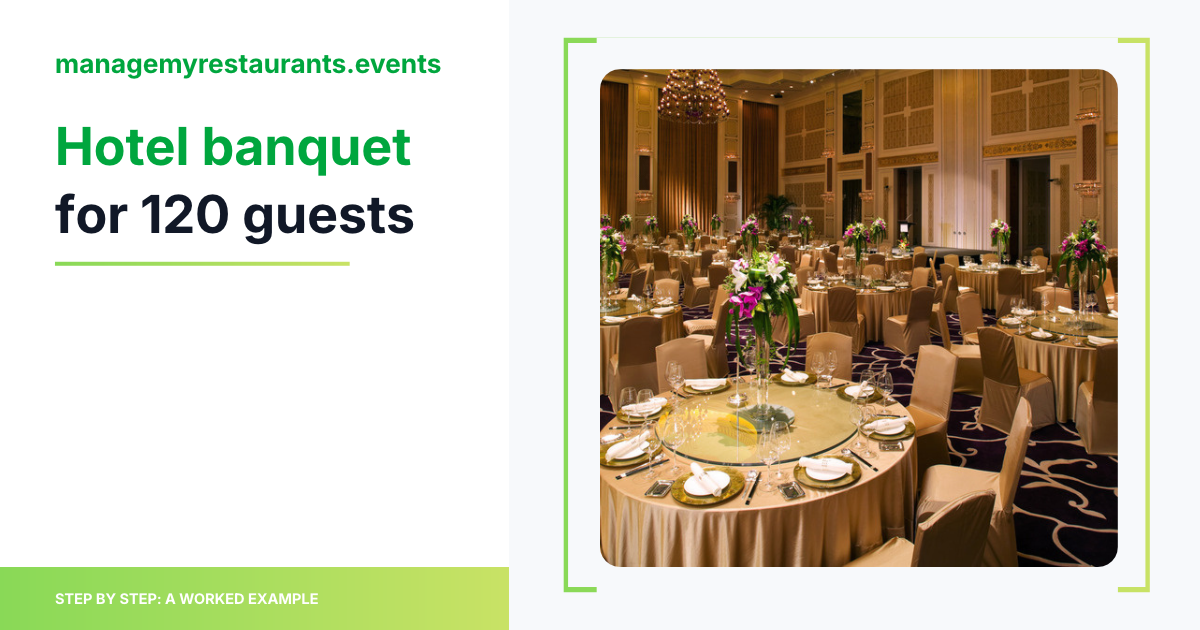
Short answer: A hotel F&B department can run a banquet from one event in Manage My Restaurants Events, from the organiser's first email to the wrap-up the morning after.
Planning. The events office saves the organiser as a client and creates the banquet with an expected guest count. The banquet menu, with its dietary variations, gives you an estimated plate cost and a shopping list for the kitchen.
Running the day. The timeline holds the room flip and the service. Tasks on a board cover the setup, shifts put the banquet team on the plan, and the organiser can follow the timeline through a share link.
Paperwork. The organiser's confirmation and the banquet kitchen sheet come from your own document templates, filled in with the event and client details, in a guest layout and a kitchen layout, ready to download or print as PDF. Together with the timeline, that's your BEO-style (banquet event order) event sheet, without retyping.
Below is one example banquet, start to finish. If you run events in a restaurant rather than a hotel, the 60-guest corporate dinner example is the closer fit.
Example event (made up for illustration): a 120-guest dinner closing a two-day regional medical association conference at a city hotel. The ballroom hosts sessions until 16:30 and is reset for dinner the same afternoon. Plated three-course dinner, a 10-minute speech by the association's president, finish by 23:30. Breakfast for hotel guests starts at 6:30 the next morning, from the same kitchen. All amounts are example figures, before tax.
Step 1: The banquet inquiry becomes a client and an event
Eight weeks out, the association's conference organiser emails the hotel's events office: "Closing dinner for about 120, plated, a short speech from our president, in the ballroom right after the last session."
The events coordinator, who has a Manager account, does two things:
Saves the client. The association goes in as the client, with the organiser as the contact. When next year's conference comes around, you start from this client record, which shows the association's past events.
Creates the event on that client, with the date, the ballroom and an expected guest count of 120. The final count goes into its own field later, so nobody confuses the inquiry number with the guaranteed one.
In many hotels, sales takes the inquiry and F&B delivers the banquet. Here both sides work on the same event: the coordinator creates it, and the F&B manager and the banquet chef plan on it.
Step 2: Hotel banquet menu with diets and plate cost
The banquet chef builds the event menu: a beetroot and goat cheese starter, braised beef cheek as the main with a vegetarian, a vegan and a gluten-free variation, and a dessert. Each dish carries an estimated plate cost that the chef enters. The main comes out at $28, the full menu at about $36 per guest. That puts the proposed package of $110 per guest in context before the quote goes out: food is roughly a third of the price. For the method, see how to cost an event menu.
Three weeks before, the organiser sends the diets: 14 vegetarian, 4 vegan and 3 gluten-free. The menu's variations cover all three. One of the gluten-free guests is coeliac, so the coordinator adds a note on the event (not on a dish) with that guest's name and table. The chef and the banquet captain then know who gets that plate.
From the menu, the app generates a shopping list for this banquet. In a hotel kitchen that also cooks for the restaurant and the breakfast buffet, a list built for one event keeps the banquet order separate. The list doesn't update by itself when the guest count changes: you refresh it manually. That matters in Step 6.
The hotel also adds the banquet's additional services and restaurant costs to the event: ballroom hire, the AV for the speech and the late bar. The event cost calculation includes the additional services alongside the menu.
Step 3: The banquet timeline, room flip included
The F&B manager builds the timeline backwards from the 23:30 finish. The hotel-specific risk is the flip: 90 minutes between the last session and a dinner-ready ballroom.
Time | Step |
|---|---|
16:30 | Last session ends, delegates leave the ballroom |
16:45 | Room flip: theatre rows out, 12 rounds of 10 in, linen and place settings |
18:15 | Ballroom ready, microphone check for the speech |
18:30 | Banquet briefing: diets, gluten-free plates, course timings |
19:00 | Welcome drink in the foyer |
19:30 | Guests seated, starter |
20:10 | President's speech (10 min). Mains wait at the pass until it ends |
20:25 | Main |
21:30 | Dessert, coffee |
23:00 | Bar closes |
23:30 | Guests out, ballroom strike begins |
00:30 | Ballroom cleared, banquet kitchen closed down |
Because the flip has its own line with a time, it gets planned and staffed like any other step. For more layouts, see event-day timeline examples.
The organiser gets a share link to the event timeline, so the association can see the flip and the service times without asking by email.
Step 4: Tasks and shifts for the banquet team
The F&B manager adds tasks to the event and sees them on the calendar and Kanban boards:
"Ballroom: 12 rounds of 10 set by 18:15" for the banquet captain,
"Gluten-free plates: separate prep area, confirm at the 18:30 briefing" for a banquet cook,
"Foyer welcome drink set by 18:50" for the bar.
Then the shifts. At 112 to 120 guests, standard plated service, the team in this example is one banquet captain, six servers, two runners and two bartenders, plus three cooks and two stewards in the banquet kitchen. To size your own, see staffing plans for 80, 100 and 150 guests.
One hotel check before you confirm the closing shifts: the banquet kitchen closes at 00:30 and breakfast opens at 6:30. Make sure the cooks closing the banquet aren't also the ones opening breakfast.
The office roles, Owner and Manager, go to the people who plan: the events coordinator, the F&B manager and the banquet chef. Servers, runners and bartenders are Staff. Staff can't create events. They get to this banquet from their shift or from a task on the board.
Step 5: Banquet confirmation and kitchen sheet
The hotel wrote two document templates once:
a confirmation in the guest layout, for the organiser,
a banquet kitchen sheet in the kitchen layout, for the chef and the pass.
Both are filled in with the event and client details: the association's name, the date, the ballroom and the guest count. The organiser's confirmation carries the menu, the timings, the price per guest and the final-count terms. The kitchen sheet carries the courses, the dietary counts and the timings. The data is the same and the layout is different. Both can be downloaded or printed as PDF: the confirmation goes to the organiser, and the kitchen sheet goes up at the pass. To see what a filled banquet sheet usually covers, see BEO examples.
Step 6: The final count, 72 hours before
The confirmation says the final count is due 72 hours before the banquet, and that number is the guarantee: the hotel charges for it even if fewer guests arrive. If that term is new to your team, see what a guest-count guarantee is.
On Tuesday at noon, the organiser confirms 112 guests: 91 standard, 14 vegetarian, 4 vegan, 3 gluten-free. The Manager enters 112 as the final guest count, updates the menu for the final diets and refreshes the shopping list manually, because it doesn't change by itself when the count does. The kitchen sheet is filled in again, so the pass works from the right numbers.
Step 7: Banquet night, run from the timeline
The banquet chef and the F&B manager work from the kitchen sheet and the timeline. Staff get to the banquet from their shift or their task. By 18:10 the ballroom is set, ahead of its 18:15 task, and the captain marks that task as done on the board.
At 20:05 the president asks for ten more minutes before the speech. The F&B manager moves the speech to 20:20 and the main to 20:35 in the timeline, and the captain tells the pass. The plan on the event stays the same as what's happening in the room.
Step 8: Banquet wrap-up the morning after
The wrap-up is three steps:
Final summary from your template. It shows the guaranteed count and the agreed price. Example: 112 guests × $110 = $12,320 before tax. 109 guests attended, and the guarantee applies.
Check the food side. At about $36 a plate, 112 guests come to about $4,032 in food, so you can see what the banquet took against what it brought in.
Charge the client in the hotel's own accounting or invoicing system, using the same details and amounts as the summary.
Manage My Restaurants Events doesn't invoice or bill. It gives you the numbers and the summary your invoice is based on.
When the association books next year's closing dinner, start from its client record: this banquet is already listed there among its past events.
FAQ
Is there a BEO generator?
No. You build a BEO-style event sheet from your own document templates and the event timeline, filled in from the same event.
We already use a sales CRM for inquiries. Where does this fit?
Manage My Restaurants Events covers the event itself: client, guest counts, menu, timeline, tasks, shifts and documents. For a side-by-side with a sales-first venue tool, see Perfect Venue vs Manage My Restaurants Events.
Run your next hotel banquet from one event
Client, guest counts, menu and plate cost, additional services, timeline, tasks, shifts and documents, all on the same event. See plans: 14-day free trial, card required.