
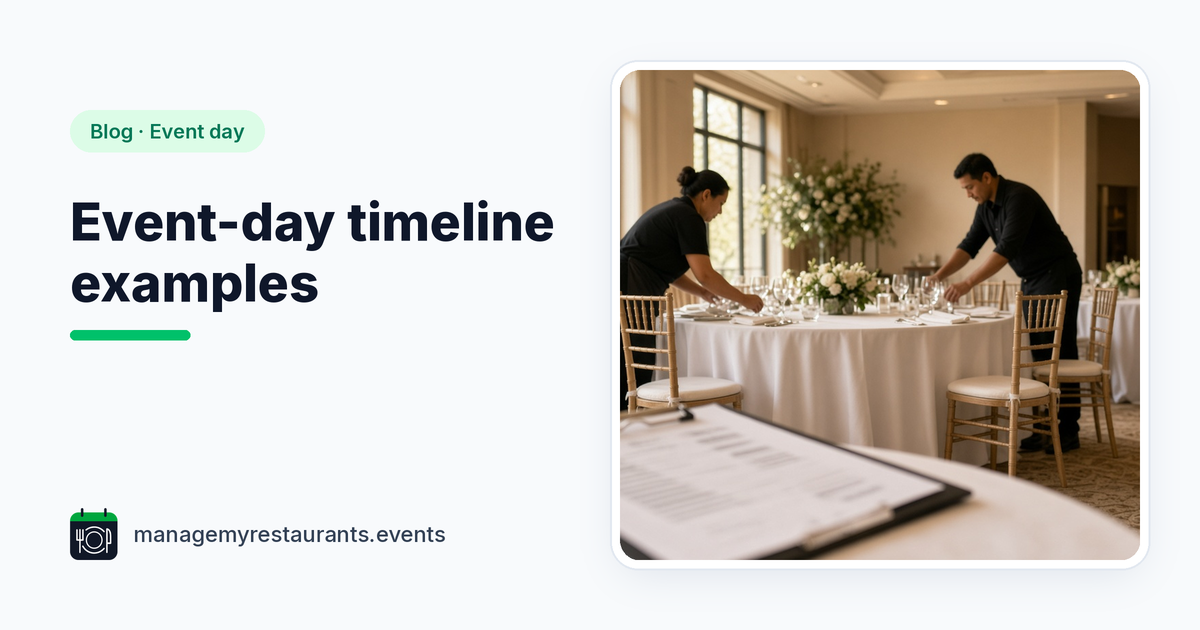
An event-day timeline is the minute-by-minute plan your team runs from load-in to the last guest out: when the kitchen fires each course, when the room flips, when speeches start and when the bar closes. Below are four worked examples — a wedding, a corporate conference day, a banquet or gala, and a private dinner — with invented times labelled as examples, so you can copy the shape onto your own event timeline template.
Each timeline is written from the venue's side, not the guest's. The guest sees "dinner at 19:00". The team needs to know that the main course leaves the kitchen at 19:55, that the runner is on the stairs at 19:50 and that the microphone check happens before the doors open. For the full day-of document the timeline sits in, see what a Banquet Event Order (BEO) is the filled BEO examples and the full guide to the BEO for restaurants and venues.
What every event-day timeline should show
Block | What it must state |
|---|---|
Time | Exact clock time, not "after dinner" |
What happens | One action per line: doors open, starter out, toast |
Who owns it | A named role: manager, head chef, bar, runner |
Guest-facing or back-of-house | So the client copy and the team copy can be separated |
Dependencies | "Main out only after speeches end" |
Buffer | 10–15 minutes before every hard point |
Guest count used | The final guarantee, not the enquiry estimate |
Two rules make every example below work. First, plan backwards from the hard points: the ceremony, the keynote, the main-course drop. Second, put a buffer before each one, because speeches always run long.
Example 1 — Wedding reception (plated dinner, 100 guests)
Example only — invented times. Ceremony off-site at 15:00, reception at the venue, plated three-course dinner, open bar, cake, dancing until 01:00.
Time | What happens | Owner |
|---|---|---|
10:00 | Kitchen prep starts; deliveries checked against the shopping list | Head chef |
12:00 | Room setup: tables, linen, place cards, cake table | Manager + floor team |
14:30 | Band or DJ load-in and sound check | Manager |
15:30 | Staff briefing: seating plan, special diets, speech order | Manager |
16:15 | Bar ready; welcome drinks poured | Bar |
16:30 | Guests arrive; welcome drinks and canapés in the foyer | Floor team, runners |
17:15 | Guests seated | Manager |
17:30 | Couple's entrance; first toast | Manager cues band |
17:45 | Starter out | Kitchen, runners |
18:30 | Speeches (two, 10 minutes each) — buffer before main | Manager |
19:00 | Main course out | Kitchen, all floor servers |
20:00 | First dance; floor opens | Band |
20:30 | Cake cutting; cake plated and served | Kitchen, floor team |
22:30 | Late-night snack | Kitchen |
00:30 | Last call at the bar | Bar |
01:00 | Music off; guests out | Manager |
01:00–02:30 | Breakdown, dishwashing, room reset | Floor team, kitchen |
Watch-outs: the gap between ceremony and arrival is where delays build up. Write who confirms the couple has left the ceremony, and hold the starter until the room is seated, not until the clock says 17:45.
Example 2 — Corporate conference day (120 delegates)
Example only — invented times. Full-day conference, plenary in the main room, two coffee breaks, buffet lunch, drinks reception at the end.
Time | What happens | Owner |
|---|---|---|
06:30 | Kitchen in; breakfast pastries and lunch prep | Head chef |
07:00 | Room setup: theatre seating, stage, registration desk | Manager + floor team |
07:30 | Audio-visual (AV) check: projector, microphones, presenter laptop | Manager, AV technician |
08:00 | Registration opens; coffee and pastries in the foyer | Floor team |
09:00 | Opening session | Client |
10:30 | Coffee break (20 min); refill stations at 10:20 | Floor team |
10:50 | Session 2; foyer cleared | Floor team |
12:30 | Buffet lunch opens; attendants on stations | Kitchen, buffet attendants |
13:30 | Lunch closes; room flip for afternoon workshops | Floor team |
15:00 | Afternoon coffee break (20 min) | Floor team |
17:00 | Closing session ends | Client |
17:15 | Drinks reception: wine, beer, canapés | Bar, runners |
18:30 | Last call at the bar | Bar |
19:00 | Guests out; breakdown | Floor team |
Watch-outs: the client's agenda changes during the day. One person owns the link to the event organiser and tells the kitchen if lunch moves by 15 minutes. Buffet lunch for 120 needs refill timing written down — see staffing plans for 80, 100 and 150 guests for how many attendants to put on the stations.
Example 3 — Banquet or gala dinner (150 guests)
Example only — invented times. Charity gala: reception, four-course plated dinner, awards, auction, dancing.
Time | What happens | Owner |
|---|---|---|
11:00 | Kitchen prep | Head chef |
13:00 | Room setup, stage, lighting | Manager, external crew |
16:00 | AV rehearsal with the host | Manager |
17:00 | Staff briefing: sections, course timings, award breaks | Manager |
18:30 | Reception in the foyer; canapés and sparkling wine | Floor team, bar |
19:15 | Doors to the ballroom; guests seated | Manager |
19:30 | Welcome from the host | Client |
19:40 | Starter out | Kitchen, runners |
20:15 | First award block (15 min) — no service on the floor | Manager |
20:35 | Fish course out | Kitchen |
21:15 | Main course out | Kitchen, all floor servers |
22:00 | Auction (30 min); bar service only | Bar |
22:35 | Dessert and coffee | Floor team |
23:00 | Dancing | Band |
00:30 | Last call; guests out by 01:00 | Bar, manager |
Watch-outs: awards and auction freeze service. Put a "no plates on the floor" line in the timeline for each block, so the kitchen does not fire a course into a silent room. With four courses and 150 guests, synchronised service needs runners — the timeline only works if the staffing behind it is named.
Example 4 — Private dinner (24 guests, private room)
Example only — invented times. Birthday dinner in a private room, tasting menu of five small courses, wine pairing, client-supplied cake.
Time | What happens | Owner |
|---|---|---|
15:00 | Prep for the tasting menu; cake into the fridge | Chef |
17:00 | Room set: one long table, place cards, wine glasses | Server |
18:00 | Briefing: allergies, pairing order, cake moment | Manager |
19:00 | Guests arrive; aperitif | Server, bar |
19:30 | Course 1 with first pairing | Kitchen, server |
19:55 | Course 2 | Kitchen |
20:25 | Course 3 | Kitchen |
21:00 | Course 4 (main) | Kitchen |
21:40 | Toast by the host | Client |
21:50 | Cake brought in, cut and plated | Server |
22:10 | Petit fours and coffee | Server |
23:00 | Room closed | Manager |
Watch-outs: small events still need a timeline, because the restaurant is serving the main dining room at the same time. The private room's courses must be slotted around the main service peak on the kitchen pass. If the client brings a cake, write when it is cut and who does it.
Side-by-side: where the hard points sit
Event | Hard points | Typical buffer |
|---|---|---|
Wedding | Arrival from ceremony, speeches, first dance, cake | 15–20 min before main |
Conference day | Session starts, coffee breaks, lunch open | 10 min before every break |
Banquet or gala | Award blocks, auction, course drops | Course held until block ends |
Private dinner | Course rhythm, cake moment | Slotted around main service |
Common timeline mistakes
Guest times only. "Dinner 19:00" tells the kitchen nothing about when to plate.
No owner per line. If nobody owns the speech cue, the main course dies on the pass.
No buffer before hard points. Speeches, keynotes and photographs always run long.
Setup and breakdown missing. The day starts hours before doors and ends after the last guest.
Old guest count. The timeline, the staffing and the menu must use the same final number — see guest-count guarantee.
Not updated after changes. A new speech or a moved ceremony means a new version, shared with everyone.
FAQ
How detailed should an event-day timeline be?
One line per action that needs a person. If a step needs someone to do something at a specific time, it belongs on the timeline.
Should the client see the same timeline?
Give the client the guest-facing lines (arrival, dinner, speeches, dancing). The team copy adds prep, setup, kitchen and breakdown.
Where does the timeline live on the day?
On the day-of sheet with the menu, guest count and staffing — a blank structure is in the BEO template. For how timelines fit the rest of your event workflow, see how to organize restaurant event operations.
What if the 2027 wedding season brings longer receptions?
Copy the shape, then move the hard points. The structure — backwards from hard points, buffers, owners — stays the same.
Copy the shape, then adjust the times
Take the example closest to your event, keep the structure, change the clock times to your kitchen and rooms. Each line gets an owner, each hard point gets a buffer, and the whole plan runs on the final guest count.
Manage My Restaurants Events is event-management software for restaurants, venues and hotels: clients, events, menus, shopping lists generated from the menu, estimated plate cost, expected and final guest counts, timelines, tasks, documents and templates, and staffing. Try it for free and keep your event-day timeline on the same event your team runs.