
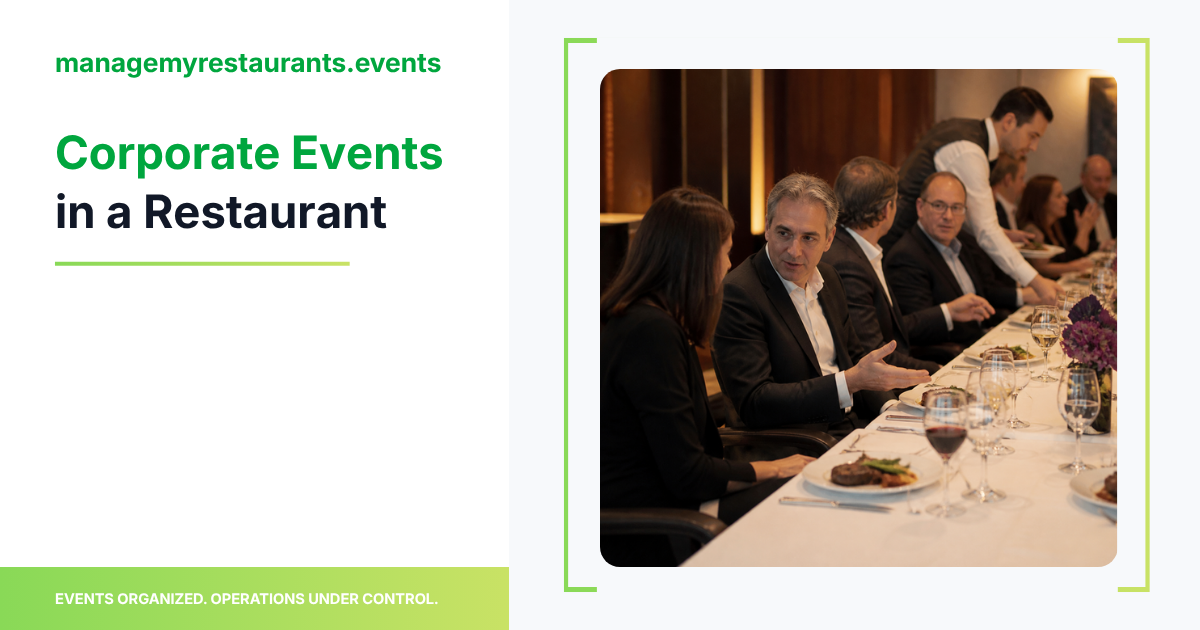
Short answer: To run a corporate event well, separate three people on the first call: the person who books, the company that pays (with its invoice details and order number), and the host who makes decisions on the night. Then build everything on the final guest count:
a menu with fixed dietary variations and a deadline for changes,
a timeline with a hard finish,
a staffing plan sized to the service format, not the headcount alone,
paperwork that matches what the client's accounts team needs to pay.
Get those four right and the 9 a.m. headcount cut, the overrunning speech and the invoice query all become routine.
This guide is for restaurants, banquet venues and hotel food and beverage (F&B) teams that host corporate events, not for the companies booking them. It covers the corporate work you'll quote across 2027: breakfasts, training days, working lunches, conference days, team dinners and client dinners. For the December season specifically, see our corporate Christmas events guide.
The corporate event types you'll quote in 2027
Corporate events look alike in the inbox ("company event, around 40 people") but run very differently. Sort the inquiry into a type before you quote, because the type decides the menu format, the staffing window and how hard the finish is.
Type | Typical shape | What matters most for the venue |
|---|---|---|
Breakfast meeting or training day | Morning start, coffee breaks, lunch, a room that stays set all day | Break timing, refills, presenter equipment, a lunch that doesn't run into the afternoon session |
Working lunch | 60–90 minutes, often on a weekday | Speed. Everything must be out quickly, and guests leave on time |
Conference day | Plenary room, breaks in the foyer, buffet lunch, sometimes a drinks reception | Room flips, audio-visual (AV) checks, one contact who tracks the agenda |
Team dinner or team-building night | Seated or sharing dinner, open bar or drinks package, sometimes an activity | Bar rules agreed in advance, a late finish, a host who can approve extras |
Client dinner | Smaller, higher spend, private room | Precise service, named dietary needs, discretion |
Seasonal party (summer party, Christmas party) | Larger numbers, packages, many similar events in a short window | Capacity, repeatable menus, staffing across several nights |
The same company may book three of these in a year. Keep one client record for the company, so the next booking starts from what you already know: who books, who pays, what they ate last time.
What to capture on the first call: corporate event checklist
The first call is where most corporate problems start, because the person calling is often not the person paying or the person hosting. Capture these before you send a quote:
The booker. Name, role, phone and email. Often an executive or office assistant.
The payer. The company's legal name, invoice address, tax ID or VAT number, and whether they need a purchase order (PO) number on the invoice. Ask who approves the invoice.
The host on the night. The person who can approve changes on the spot: an extra bottle, ten more minutes, a moved speech. This is often a different person from the booker.
Date and time window, including the hard finish. When must guests be out? When does the room need to be reset for your evening service?
Expected guest count and the date for the final number. Agree when the final count is due and what you charge if it drops. If you work with a guest-count guarantee, say so now.
Format. Seated, buffet, standing with canapés, or a mix.
Agenda. Speeches, presentations, awards, a product demo. Ask when they happen and how long they run.
Dietary needs: method and deadline. Who collects them (usually the booker), in what form, and by when.
Drinks policy. Open bar, a fixed package, a spend cap, or soft drinks only. Company policies vary.
AV and room needs. Projector, screen, microphones, a lectern, Wi-Fi details, a presenter's laptop.
Name list. If you need names for place cards, badges or building access, ask for the list 48 hours before.
In Manage My Restaurants Events, you'd create the event with the company as the client and record the expected guest count straight away. The final count goes into its own field when it arrives, so nobody confuses the inquiry number with the guaranteed one.
Corporate event menu that survives the 9 a.m. headcount cut
Corporate guest counts move late. People drop out the morning of the event, and someone in the office emails "we're 9 fewer" at 9 a.m. The menu has to absorb that without waste or a scramble.
Build variations into the menu, don't improvise them. Agree a fixed set up front: a standard main, a vegetarian main, a vegan option and a gluten-free option, plus how you handle named allergies. Ask the booker for counts per variation and the names behind any allergy. The kitchen needs the number of each plate. The floor needs to know which guest gets which.
Set a cut-off and stick to it. For example, final count and diet counts by 12:00 two working days before. After that, changes are best-effort and the guarantee applies.
Choose dishes that scale. Plated mains prepped to the guarantee, with sides and starters that hold well, cope with a morning cut far better than dishes cooked to order.
Re-run the numbers when the final count lands. Update the menu quantities to the final count, then generate the shopping list again from the updated menu. The list doesn't update by itself, and regenerating it means you order from current quantities rather than last week's. The estimated plate cost next to each dish shows what the change does to food cost before you confirm it. For the costing method, see how to cost an event menu before you send the quote, and for how menus and shopping lists work in the product, see event menus.
Example: a lunch for 48 guests at an estimated plate cost of $22 is $1,056 of food. If the final count drops to 39 after the cut-off and you charge the guarantee, the food cost stays fixed but the client pays for 48. If you prep only for 39, you save $198 of food, but only if the kitchen hears the new number before ordering.
Corporate event timeline with a hard finish
Corporate events almost always have a hard finish. The client's team has a train to catch, the room has to be reset for evening service, or the hotel ballroom has another function at 19:00. Build the timeline backwards from that finish.
Put the hard finish at the top and plan backwards: last drinks, dessert, main, starter, arrival.
Speeches and hot plates don't mix. Agree where speeches go: before the main course, between courses, or after dessert. Write a hold point into the timeline: "main course leaves the pass only when the CEO's speech ends." Fifteen minutes of speeches over plated mains is how food dies on the pass.
Add a buffer before every fixed point. Presentations and speeches run long.
Include the turnaround. If the room becomes your à la carte dining room at 19:00, the timeline ends at 19:00 with the room reset, not with guests leaving at 18:55.
In Manage My Restaurants Events, the timeline sits on the event, and you can share it by link with people who don't have a login: the client's host, an external AV technician or a speaker. They see the current plan instead of last week's email. For worked examples, see event-day timeline examples.
Audio-visual (AV) as a priced service
AV is where corporate events quietly lose money. "Can we plug in a laptop?" turns into a projector, a screen, two microphones, an adapter hunt and a staff member standing by the sound desk.
Price AV as its own line, not inside the per-person price, so the client sees it and the venue covers its cost. Example: a projector, screen and two microphones at $350 per event, plus a technician at $45 per hour if needed.
Name who operates it. Your team, the client's team or an external technician.
Put the AV check on the timeline, at least 30 minutes before doors, with the presenter's actual laptop and adapters.
Write down the Wi-Fi details and the presentation format in advance. "We'll bring it on a USB stick" is not a plan.
In Manage My Restaurants Events, add AV to the event as an event extra, so it sits on the same event as the menu and guest count instead of in a separate note.
Staffing a 90-minute lunch vs a five-hour corporate dinner
Two events with the same guest count can need very different teams. A working lunch is a short, intense window. A corporate dinner is a long shift with setup, a bar and breakdown.
90-minute working lunch (example, 40 guests) | Five-hour corporate dinner (example, 40 guests) | |
|---|---|---|
Service shape | Everything out quickly; guests back at their desks on time | Courses paced around speeches; bar open all evening |
Floor | More hands for a short time, so plates go out together | Fewer servers per hour, but for a long shift with breaks |
Bar | Soft drinks and coffee, often self-service | A dedicated bartender for the whole evening |
Kitchen | Mise en place done before doors; a fast pass | Paced firing, a hold point for speeches |
Hours to cost | Setup + 90 minutes + quick clear | Setup + 5 hours + breakdown + room reset |
Use your own ratios or the staffing plans for 80, 100 and 150 guests, then cost the hours, not just the headcount.
In Manage My Restaurants Events, staff open the event through their shift or a task, so they see the menu and timing for the event they're working. The Owner or Manager plans the event and the team. If the client moves the speeches on the day, update the timeline on the event so the team works from the new times.
Paperwork the client's accounts team will actually pay
A corporate event isn't finished until your invoice is paid, and corporate invoices get stuck on details. Two documents, sent before and after the event, should carry everything the client's accounts team needs to approve your invoice.
Before the event: a confirmation. It should include:
the company's legal name, tax ID or VAT number and invoice address,
the PO number, if the client requires one,
the date and time window,
the expected guest count and the date the final count is due,
the per-person price and what it includes,
AV and other extras as separate lines,
the drinks policy and the cancellation terms.
After the event: a final event summary. It should include:
the final guest count you are charging for,
any extras actually used (for example, an extended bar),
the same PO number and invoice details as the confirmation.
Then the invoice, which is your step. Issue it from your own invoicing or accounting system, using the same company details, PO number and amounts as the two documents. If the numbers match what was agreed, the invoice goes through.
In Manage My Restaurants Events:
Templates. You write the confirmation and the final summary once, as document templates. Placeholders fill from the event and the client, and you export the result to PDF.
Layouts. The same event can produce a guest-facing layout for the client and a kitchen layout for your team.
Costs. Extras such as AV are recorded on the event as event extras, and your own costs as restaurant costs, so you can check what was added before you invoice.
Invoicing. The app doesn't issue or send invoices; that stays in your own system.
A BEO-style packet (banquet event order) is a template filled from the event plus the timeline. For what goes into one, see BEO examples.
What changes in 2027: notice periods, more dietary requests, venue choice
Each point below comes from a dated, published source. The surveys come from different markets, so read them as signals, not as rules for your city.
Planners are optimistic, but cost-conscious. In the Amex GBT 2027 Global Meetings and Events Forecast (500 meetings professionals in 11 countries, surveyed in August 2026), 93% are optimistic about the sector in 2027 and 91% expect their meetings and events spend to rise. 30% report smaller meetings or a change of venue in response to geopolitical instability (Amex GBT, 13 Oct 2026).
Restaurants are on the shortlist. Reporting on the same forecast, Hotel Dive notes that cost has become planners' number-one priority when selecting a venue. It also notes a shift from traditional hotels toward alternative spaces such as restaurants, cultural sites and boutique venues (Hotel Dive, 14 Oct 2026).
Notice periods are moving in different directions. In Australia and New Zealand, 85.4% of planners surveyed by VenueNow planned to book zero to six months out (VenueNow, Feb 2026). In the Executive PA 2026 Corporate Event Organiser Survey (Summer 2026 issue, Australia), 66% of executive assistants said they get less than three months' notice for events under 100 guests, up from 60% in 2019 (Executive PA, Summer 2026). In North America, by contrast, planners told Amex GBT they plan to build in longer lead times (Hotel Dive). Practical takeaway: have a ready-to-send package for short-notice corporate lunches and dinners, and still hold space for the larger events booked early.
Fast replies matter. 76% of planners in the VenueNow survey expect a venue to respond within 24 hours, and 76.2% prefer the venue's in-house AV (VenueNow).
More dietary requests, less alcohol. In the IACC Meeting Room of the Future report, 2026 edition, which surveyed 124 venue operators worldwide, 89% reported an increase in requests for dietary preferences and 57% noted reduced alcohol consumption among attendees (IACC, 2026 edition). Plan a strong non-alcoholic offer and fixed dietary variations, rather than treating them as exceptions.
The booker is often an assistant doing this on top of their main job. In the VenueNow survey, 87% of planners organise events alongside their primary role, and assistants were the most common job title (35%) (VenueNow). A clear first-call checklist and one confirmation document save them, and you, a lot of back-and-forth.
FAQ
How far ahead should a restaurant take corporate bookings in 2027?
There's no single answer. Published surveys show shorter notice in some markets and longer in others. Keep a short-notice package ready (fixed menu, fixed variations, set AV price) for lunches and dinners booked within weeks, and set clear deadlines for the final count and dietary choices on every booking.
How should I handle dietary requirements sent by an assistant?
Ask for counts per variation and the names behind any allergy, by a fixed deadline. Put the counts on the event menu so the kitchen preps the right plates, and agree how the floor will identify each guest with a special meal.
Should I charge the guaranteed or the actual guest count?
Agree it up front and write it into the confirmation. If you work with a guarantee, say clearly that the guaranteed number is charged once the deadline for the final count passes. See what a guest-count guarantee is.
Can the client's host or AV technician see the plan without an account?
Yes. In Manage My Restaurants Events, you can share the event timeline by link with people who don't have a login.
How is a corporate Christmas party different?
It's the same process under seasonal pressure: many similar events in a short window, packages, and staffing across several nights. See the corporate Christmas events guide.
Run your 2027 corporate events on one plan
Corporate clients remember two things: that the event ran to time, and that your invoice matched what they agreed. Manage My Restaurants Events keeps the client, menu, guest counts, timeline, staff and documents on the same event, so the kitchen, the floor and the office work from one plan. See plans: 14-day free trial, card required.
Sources
Amex GBT, 2027 Global Meetings and Events Forecast press release, 13 Oct 2026: https://www.amexglobalbusinesstravel.com/press-releases/2027-global-meetings-events-forecast/
Hotel Dive, "Global meeting professionals overwhelmingly optimistic about 2027: report", 14 Oct 2026: https://www.hoteldive.com/news/global-meeting-event-forecast-2027/832946/
VenueNow Annual Outlook Survey (Australia and New Zealand, January 2026), published 2 Feb 2026: https://venuenow.com/blog/venuenow-annual-outlook-survey/
Executive PA, 2026 Corporate Event Organiser Survey, Summer 2026 issue (Australia): https://www.appa.com.au/assets/2026-Executive-PA-Corporate-Event-Organiser-Survey-compressed.pdf?vid=4
IACC and Development Counsellors International, Meeting Room of the Future Barometer, 2026 edition: https://www.karstens.com.au/hubfs/Meeting Room of the Future - IACC 2026.pdf