
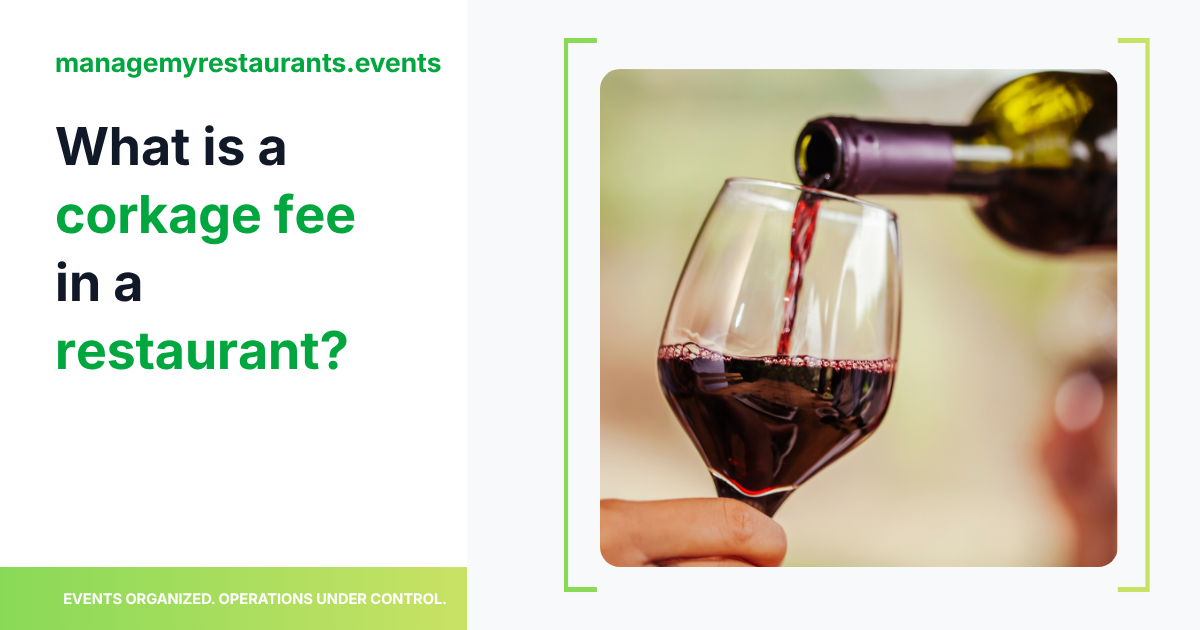
A corkage fee (also called corkage) is what a restaurant or event venue charges when a client brings their own alcohol and the venue agrees to chill, open, pour, and clear it during service. It is not a tip and not a drink price—it is a commercial charge for lost beverage margin plus the labour and glassware that still sit on your side of the pass.
For private dining, corporate dinners, and booked events, corkage is a policy decision, not a favour. If you allow outside bottles without a clear fee and service scope, you give away bar revenue and still pay for staff time, ice, glassware, and cleanup. Put the rule on the contract and on the Banquet Event Order (BEO)—not only in a sales email.
Why venues charge corkage
Beverage is often one of the highest-margin lines on an event P&L. When the client supplies the bottles, that margin disappears. Corkage recovers part of it and pays for what the floor and bar still do:
Glassware, ice, chill space, and wine buckets
Opening, pouring, topping up, and clearing empties
Storage on arrival and disposal or return of leftovers
Extra bar or floor labour when bottle volume is high
If the fee does not cover those costs—or the team hears “corkage yes” with no extra staffing—the venue loses twice: no house-bar sales and unpaid service load. For headcount when bar service is heavy, see how many servers you need for 100 guests.
Common pricing models
There is no single national corkage rate. Markets and venue tiers vary. In Poland, operators often see roughly 10–50 PLN per bottle as a working range, but premium rooms, city hotels, and per-guest models sit outside that band. Publish your own price list; do not invent a “standard” national figure.
Model | How it works | Best when | Watch-outs |
|---|---|---|---|
Per bottle brought | Fee × every bottle that enters | Easy intake control | Client may bring more than will be opened |
Per bottle opened | Fee × bottles opened in service | Feels fair to the client | Needs a count sheet; disputes at close |
Per adult guest | Flat fee × drinking-age (or all) guests | Large events; messy bottle counts | Define who counts; non-drinkers |
Flat event fee | One corkage package for the booking | Predictable quote; simple BEO line | Underprices if volume explodes |
Some venues mix models (e.g. flat fee up to N bottles, then per bottle). State the unit, rate, VAT treatment, and what is included—before the deposit.
Corkage vs house bar
Corkage (BYO) | House bar / beverage package | |
|---|---|---|
Margin | Partial recovery only | Full beverage margin |
Control | Client chooses brands and quality | Venue controls stock, quality, pour |
Ops load | Still glassware, chill, pour, clear | Stock and prep end-to-end |
Fit | Special wines, gifts, client brand | Most corporate dinners; high volume |
What the fee should include
Spell this out so sales, the client, and night-of ops share one definition:
Permission — allowed categories (wine only; wine + spirits; no homemade; no open bottles on arrival)
Intake — delivery window, who receives, where stored, labelled count on arrival
Service — chill, open, pour, glassware, who pours (venue staff only is the safer default)
Limits — max bottles / spirits and any house rules
Close — leftovers sealed and returned, held for pickup, or disposed of
Billing — unit of charge, brought vs opened, VAT as a service line on the invoice
If something is not included (decanting, a dedicated spirits bartender), say so. A fee with no service description starts night-of arguments.
Contract and BEO
Commercial terms belong in the contract. Day-of execution belongs on the BEO / event sheet. Both must match.
Contract: allowed categories; pricing model and count method; delivery/pickup windows; liability for client stock; who may serve; leftover rules; VAT as a service per your accounting policy and local rules (not a resale of the client’s bottles).
BEO — see the BEO field guide for restaurants and venues: corkage yes/no; categories; expected bottle count and billing basis; delivery time and receiver; bar/floor owner for pour and count sheet; glassware and chill plan; leftover disposition; pointer to the signed contract clause so a revised BEO cannot silently rewrite the deal.
Corporate holiday dinners are a frequent corkage-request season. Related: corporate Christmas events for restaurants (2026).
When corkage makes sense—or refuse
Makes sense when: food and room already carry healthy margin; volume is limited; the client accepts venue pouring and a written count; you have chill space, glassware, and staffing; cultural or brand reasons matter and the fee is priced honestly.
Prefer house beverages—or refuse BYO—when: beverage is a core profit centre for that room or date; the ask is open spirits for a large guest count with thin staffing; delivery or storage is unsafe; quality or liability is unclear; the client wants self-service that breaks your alcohol-service rules.
Refusing is a product decision. “House bar only for this format” is clearer than a vague maybe that collapses on the night.
Common mistakes
Vague policy — “We allow corkage” with no rate, categories, or service scope.
Fee with no service — charging per bottle while expecting the client to pour, or leaving empties with no close plan.
Not on the BEO — sales agreed it; bar never staged glassware or chill.
Guest-count vs bottle-count confusion — quote and night-of count use different units; settlement fights follow.
No leftover rule — unlabelled open bottles in the walk-in; nobody owns return or disposal.
Understaffing the pour — corkage approved, bar still rostered water-only.
FAQ
Is corkage the same as a beverage package?
No. A package sells your stock at your margin. Corkage pays for permission plus service on the client’s bottles—usually less margin, still real work.
Per bottle or per guest?
Per bottle (brought or opened) when you can count stock cleanly. Per guest or flat fee when mid-service counting is impractical. State the unit in writing.
Does corkage replace bar staffing?
No. Someone still chills, opens, pours, and clears. High bottle volume needs the same roster thinking as a busy house bar.
Can the client’s staff or guests pour?
Only if policy and licence practice allow it. Many venues keep pouring with trained staff. Put the rule on the contract and BEO.
Where does the team see it on the day?
On the BEO beverage section—count method, delivery window, owner, leftover plan—not only in the sales folder.
Keep corkage on the event plan
Corkage works as ops when the same event record holds menu, shopping list, plate cost, documents, run-of-show, and staffing next to the beverage rules. Manage My Restaurants Events is an event hub for that night-of picture—so corkage notes, BEO lines, and the floor roster stay on one current plan. Try it for free when you want the policy you sold to match what the team runs.